- Mon - Sat: 10:00 - 18:30
- Call: +91 70 36 37 38 39 (Hyderabad) | +91-9505902476 (Vijayawada)

 Global Degrees
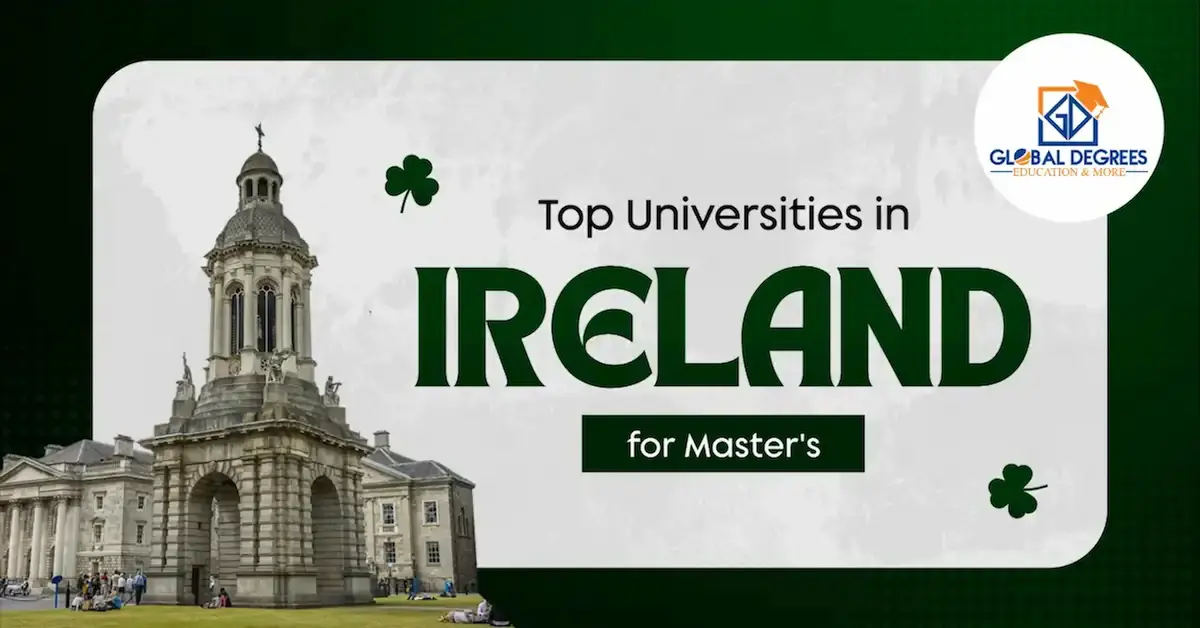
Picking the right university for a master’s in Ireland is not just about grabbing the highest-ranked name you see on some ranking list. What the course actually looks like, the tuition fee, the location, the entry requirements, and even the specializations that are available can end up mattering a lot more, depending on what a student intends to study and where they want to go next.
The universities in Ireland for master’s include solid, established places like Trinity College Dublin and University College Dublin, along with universities that are known for technology, business, engineering, and applied learning in a hands-on way. Global Degrees brings together around 10 options, and then it looks at what makes each one distinct. So students can compare more easily, based on what they want in a course, their budget, and how they prefer to study.
If you are a student thinking about where to finish your postgraduate education, choosing to study in Ireland might be a decent move, because you can end up with access to one-year taught programs, research degrees, and courses that lean more industry-focused. Most universities around the country run master’s programs in fields like business, computing, engineering, science, and healthcare, although the way each course is set up can differ from institution to institution.
Quite a few taught master’s programs in Ireland can be completed within one year, so a student can pick up a postgraduate qualification without signing up for a longer study window. Still, the actual course length varies a lot, depending on the program and how the study is arranged.
Ireland offers master’s programs in topics like artificial intelligence, data analytics, computer science, business analytics, finance, engineering, and biotechnology. In that way, students have room to select a program that fits their prior education and the career they want to pursue.
A few of the programs come with hands-on projects, placements, or coursework that’s more industry-linked. The exact opportunities tend to shift depending on the course, so it’s worth checking the particular program details before you apply.
If you are an eligible international graduate and you finish an NFQ Level 9 qualification, you might be able to join Ireland’s Third Level Graduate Programme. Under the current rules, eligible Level 9 graduates may receive up to 24 months of permission, with the second 12-month period subject to the program’s conditions.
For students comparing universities in Ireland for masters, this table gives a quick view of key study choices and popular master’s areas, plus the main strengths. Study Abroad Consultants in Bangalore can also assist students, so they can compare these factors while they start narrowing down which universities to pick.
| Institution | Location | Strongest For |
| Trinity College Dublin | Dublin | Research and global reputation |
| University College Dublin | Dublin | Business and technology |
| University College Cork | Cork | Research and science |
| University of Galway | Galway | Technology and MedTech |
| University of Limerick | Limerick | Applied learning |
| Dublin City University | Dublin | Industry-focused study |
| Maynooth University | Maynooth | Research-led study |
| Technological University Dublin | Dublin | Practical and technical education |
| Technological University of the Shannon | Midlands & Midwest | Applied programs |
| South East Technological University | Southeast Ireland | Industry-focused study |
The top 10 universities in Ireland for master’s include long-standing research universities and newer technological universities; each one tends to have different strengths across their academic fields. Rather than picking just the name, students can compare the study programs, subject areas, teaching style, where the campus is, and how relevant it can be for careers, so they can land on an option that actually matches their plans.
Trinity College Dublin sits at #75 in the QS World University Rankings 2027, and it has the best position among Irish universities in that list. You could say its central Dublin campus, plus that long-term research focus, makes it a solid choice for people who want a well-established academic environment.
Its postgraduate portfolio stretches across business, computer science, data and AI, engineering, health sciences, humanities, and social sciences. Current options include MSc Business Analytics and AI for Management, plus MSc Computer Science, and also MSc Computer Science – Data Science. There are also a few engineering master’s programs. For anyone looking at the top universities in Ireland for master’s, Trinity comes up, mainly because of its research environment, the subject range, and its international academic reputation.
University College Dublin is listed around #=100 in the QS World University Rankings 2027, so it ends up inside the top 100 universities worldwide. The big research scene in Dublin means students can tap into a wide pool of postgraduate options across business, technology, science, and a few other areas too.
For students looking at the best universities in Ireland for masters, UCD offers programs across business, business analytics, computer science, data, biotechnology, and engineering. The Dublin location makes the whole thing feel more like an internationally oriented study setting.
University College Cork, or UCC, ranks #220 in the QS World University Rankings 2027, and it’s based in Cork while providing fairly wide postgraduate options. The master’s degrees span business, health, science, engineering, sustainability and also food-related studies, so that learners can look at multiple, quite specific routes depending on what they are aiming for.
For students who like to look around and study outside Dublin, Cork gives you a different mood, yet you still get access to a research-intensive university. UCC can be a good option if you are into research-led areas, like health, science, sustainability, or even food studies. The academic range is broad enough that students can explore master’s programs in established disciplines, with topics shaped by what researchers are working on right now.
The University of Galway is ranked at #275 in the QS World University Rankings 2027 and covers a postgraduate portfolio across technology, business, engineering, health and a few other areas. In practice, it has 200+ postgraduate courses, including master’s degree options in Artificial Intelligence, Data Analytics, Adaptive Cybersecurity, Business Analytics and also Health Data Science.
Its location also gives the university a strong link to Ireland’s medical technology sector, alongside already established strengths in data and IT. For students looking at the top universities in Ireland for master’s, Galway stands out for those technology-centered programs that blend computing and data skills with healthcare and business-related areas.
The University of Limerick sits at #=388 in the QS World University Rankings 2027, and it also delivers postgraduate study across engineering, business, science, health, education, and the arts, humanities and social sciences. You can find full-time as well as part-time routes, though some courses are tailored for hands-on learning and real-world professional use. Overall, its postgraduate portfolio is built to support practical learning, rather than only theoretical coverage, and that general approach shows up across multiple disciplines.
Its Limerick location gives students an alternate path for studying instead of Dublin, yet the way it’s linked to industry can add that more hands-on, practical feel to postgraduate learning. If you’re looking for a master’s program that mixes academic depth with professional relevance, the University of Limerick can be a strong choice. Study Abroad Consultants in Hyderabad can also guide you to check course needs and possible application routes based on your academic profile, so nothing important gets missed.
Dublin City University sits at around #408 in the QS World University Rankings 2027, and it has a postgraduate portfolio that stretches across business, computing, engineering, law and communications. The Dublin location also places students near a big cluster of employers, plus professional services.
If you are thinking about the best universities in Ireland for masters, DCU can be a good fit, especially if your priority is mixing postgraduate study with hands-on competencies for technology, business, and communications careers.
Maynooth University sits at around #721–730 in the QS World University Rankings 2027, and it’s based in the historic town of Maynooth, County Kildare, roughly 25 km out of Dublin. The university has a research-led mindset, with academic strengths across the humanities, social sciences, and natural sciences.
Its postgraduate options also spill over into computer science, electronic engineering, business and law, so students can pick from more than just its usual academic strengths. For students who want a way into Dublin but do not want to study inside the city itself, Maynooth gives a different background, while still keeping close ties to the capital. The mix of active research and a spread of taught master’s choices makes it something worth putting on the list, especially for learners whose topic lines up with what the university does best.
Technological University Dublin (TU Dublin) was set up as Ireland’s first technological university, and now it has campuses spread across Dublin.
Its current master’s portfolio includes Computer Science, Data Science, Applied Cybersecurity, Human-Centered AI, Sustainable Cloud Computing, Engineering, Management and Marketing. Several full-time master’s programs can be completed in one year, depending on the course. Unlike a traditional research university, TU Dublin puts more weight on hands-on and industry-relevant learning, which makes it a practical option for students who want professionally focused postgraduate study.
Technological University of the Shannon: Midlands Midwest (TUS) runs six campuses across the Midlands and Midwest, and it provides taught and research postgraduate programs in full-time and part-time formats. The master’s catalog covers a wide range, including data analytics, business analytics, digital marketing, software engineering, AI, cybersecurity, engineering, digital health, and biopharmaceutical technology.
The university’s applied approach shows up in programs that connect coursework with day-to-day professional work and industry needs. The multiple campus locations give students a bit more flexibility when they are comparing where to study in Ireland.
South East Technological University (SETU) has master’s options across business, computing, engineering, science, health, and education, with courses that seem centered on hands-on learning and professional practice. The campuses across Ireland’s southeast give students an alternative to studying in Dublin, while keeping postgraduate options linked to regional industry needs.
With campuses across Waterford, Carlow, Wexford, and Wicklow, SETU offers students a few different places to consider when deciding where to study. The programs mix classroom learning with hands-on projects and connections to local employers. This can be handy for learners who want real-world exposure alongside their master’s qualification.
The overall cost depends on the university and course, plus the living setup. Study Abroad Consultants in Kerala can help students gauge the final budget by looking at tuition, where you will stay, meals, local travel, insurance, and a few other study-related expenses.
| Expense | Indicative Cost |
| Tuition fees | ₹12 lakh–₹45 lakh+ per year |
| Accommodation | ₹67,000–₹1.68 lakh+ per month |
| Food & daily expenses | ₹28,000–₹45,000 per month |
| Transport | ₹5,600–₹11,200 per month |
| Health insurance | ₹34,000–₹67,000 per year |
| Visa/immigration costs | Varies |
| Study materials | Depends on the course |
Admission requirements can be different, depending on the university and even the specific program, so applicants usually need a recognized bachelor’s degree, plus the right academic background. It also helps to look up the course page, because several programs come with extra conditions, or a little more in the fine print.
The subject a student chooses affects more than just the syllabus. Course duration, tuition, academic prerequisites, and also the overall balance between theory and practical work can shift quite a lot from one field to another. Study Abroad Consultants in Chennai can help students look at these aspects side-by-side before they commit to a particular program.
Computer Science is a practical route for graduates who are curious about software, computing systems, or more advanced digital technologies. The programs can span software engineering, data science, AI, cybersecurity, and cloud computing, depending on the school. For example, Trinity College Dublin provides a one-year MSc with specialist strands in Data Science, Intelligent Systems, Future Networked Systems, and Augmented and Virtual Reality.
An MBA is usually set up around management and business-style decision-making, with topics like strategy, finance, leadership, and entrepreneurship. Most full-time programs can run roughly one year, depending on the school. And unlike a lot of other academic master’s degrees, certain MBA programs expect candidates to bring prior professional experience along with them, not just a fresh academic background.
AI is also a specialized path, with typical coursework based around machine learning, intelligent systems, natural language processing, and relevant computing techniques. Background in maths or programming could also be helpful. Tuition for this path can fall in the Science & Technology range and be in the region of ₹16.8 lakh to ₹33.6 lakh.
A Data Science or Analytics master’s degree can suit people who want to work with big datasets, in finance, healthcare, marketing, or technology. The coursework can cover statistics, predictive modeling, data visualization, and machine learning, sometimes with a research angle too. University of Galway offers an MSc in Health Data Science, and over at UCD and DCU there are programs that are more centered on data and analytics.
This area touches biological investigation, bioprocessing, and drug design, along with pharmaceutical uses. At the same time, University College Dublin, Trinity College Dublin, and University College Cork offer postgraduate study in related areas. For 2025/26, the non-EU postgraduate fee for Science and Technology is around ₹16.8 lakh–₹34.7 lakh.
Education master’s degrees are often studied by people working as teachers or in education roles, or recent graduates going into research or leadership within education. Typical topics include learning, assessment, policy and curriculum. There are sometimes part-time options and fees vary across degrees and institutions.
There are various specializations such as mechanical, electronics, software, biomedical, and engineering management. For most tech degree programs, you’ll need a similar Bachelor’s degree. The fees for non-EU Engineering postgrad degrees range from about 16.8 lakh to 33.6 lakh for 2025-26; however, this may vary per course.
Start with the master’s program rather than jumping straight to the university name. When you do that, compare the curriculum, the specialization choices, course duration, teaching format, internship or project parts, and the academic prerequisites. Then check the total tuition fee for international students and estimate living costs using the university location. A very highly ranked university might still not be the best fit for every subject, or maybe not for your particular goals.
Location should also be part of the decision, because accommodation and daily expenses can shift a lot between cities. Some students might very much prefer a Dublin campus, yet others will probably find a smaller city more suitable for them. So before you make a shortlist, you should check scholarship availability, application deadlines, English-language requirements, accommodation options and even post-study plans. Irish institutions set their own admission requirements, so the last check should always be done against the specific course page.
International students can explore:
International students who are registered in suitable full-time courses may take on part-time work during their master’s, but only if it follows the conditions written on their immigration permission. If someone is holding Stamp 2, then they are allowed to work for as much as 20 hours each week in term time; this means they can earn some practical, real-world experience while still doing their studies.
The limit increases to 40 hours per week during the permitted vacation periods, including June to September and from 15 December to 15 January. Part-time work can help with daily expenses, plus give some job and workplace experience, but students should still have enough saved money to pay for tuition and living costs. That way they are not forced to rely entirely on employment income.
Picking a master’s in Ireland depends on the program almost as much as the university. The fees and specialization, plus location and entry requirements, can vary, and even future career plans matter, so the best option is not the same for everyone. The top 10 universities in Ireland for master’s give you varied paths across business, technology, engineering, science, and a few other related areas. When you compare the actual program structure and what it costs, students can usually narrow things down without leaning on rankings only. Global Degrees can help students match a suitable university and also plan the application process in a more careful way.
A master’s degree does not automatically lead to permanent residence in Ireland. Eligible Level 9 graduates may first qualify for the Third Level Graduate Programme, which provides temporary permission to seek eligible employment. Long-term residence depends on meeting the requirements of the relevant immigration route.
An Irish master’s program can be recognized in India, but it depends on the Irish university, the exact qualification structure, and also why you’re studying. In practice, students should verify the requirements of the relevant Indian institution or the specific authority that will assess it.
Ireland can feel quite expensive for Indian students, especially once you add tuition and living costs together. Dublin is usually pricier than several other regional places, so budgeting often needs more attention there, including rent, transport, and daily expenses.
There is no single official 2026 rejection rate that reliably represents all student visa applications. Decisions are based on factors such as finances, documentation, academic history, and the study plan.
Indian students can apply to eligible Irish universities if they meet the academic, English-language, financial, and visa requirements for their chosen program.
There is no standard GPA for all universities. It depends on the university, course, and the qualification of the applicant.
Many taught master’s programs accept recent bachelor’s graduates without professional experience. Work experience is more likely to be requested for professional courses, particularly some MBA programs, so applicants should check the specific admission criteria.

WhatsApp us





WhatsApp us